This is an old revision of the document!
Table of Contents
Divination
Many forms of divination were used in pre-Christian Mesoamerica, a number of which have survived to this day. Traditional methods include calendric divination, sortilege (the casting of objects onto a surface, cloth, or recepticle and their landing positions read), dream interpretation, scrying, and others.
The Tonalpohualli
Arguably the most widespread method was calendar-based using the sacred day count - Tonapohualli. This calendar featured 20 daysigns which would all influence the outcome of your life. Some days were auspicious, some were unlucky. For example people born under the sign of Cipactli were thought to be destined to be hard-working and honest. 1) The significance of these days were not limited to birthdays but also held significance for daily activities such as farming, fishing, and worship, as well as the beginnings of endeavors.
Maize-kernel casting
Often advice was sought from a “daykeeper”, or Tonalpouhque, who would determine the possible “good” or “bad” days affecting illnesses, dreams, or events. In addition to consulting the Tonalpohualli, the daykeepers would also cast maize kernels as a divinatory tool to help them better interpret the calendar. 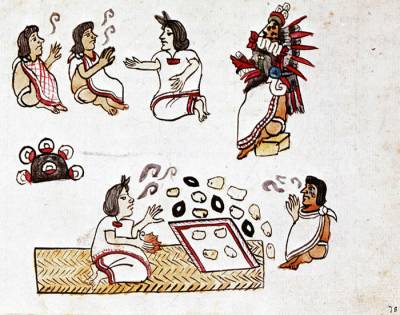 The maize served as an extension of the earth and the Teteoh representing the sacred, and was also a vehicle of communication between humans and ancestors and other divinities. Today, the most common method of maize-casting uses 16 or 18 kernels of different colors, and distinguishes between the two sides of the kernel as the side facing up in the casting will influence the interpretation. As a generalization, the front side is seen as typically “positive” and the back side is “negative”. The maize is cast on top of a piece of cloth and the positions of the thrown maize are then interpreted and given narrative. 2)
Obsidian mirrors
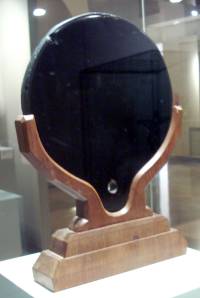 The patron Deity of sorcerers and diviners was Tezcatlipoca, who was also heavily linked to the fate of people's lives. And as mirrors were one of His symbols, it also was a powerful divinatory tool. By interpreting the reflective surface, one could gain information from the unseen worlds. It was also through an obsidian mirror that Tezcatlipoca was thought to be all-seeing, having mastered the art of mirror divination.
It was a common greeting to be met with 'You have come to see yourself in the mirror, you have come to consult the book' as one entered the home of a diviner. 3)
Other forms of divination
Other common methods of divination were water scrying, which is the act of interpreting images seen reflected through a bowl of water, throwing or pulling knots, interpreting dreams, reading smoke, and ingesting hallucinogenic plants. 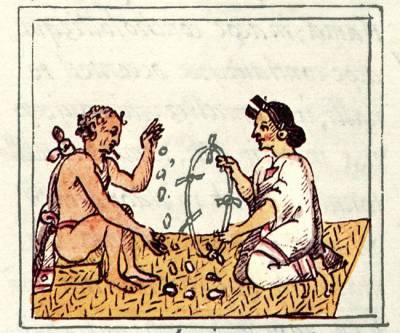
The Nahua also had other divinatory professions such as Ticitl, often referred to as a medicine man, or the Tlaolxiani who is more directly linked with divination. 4)